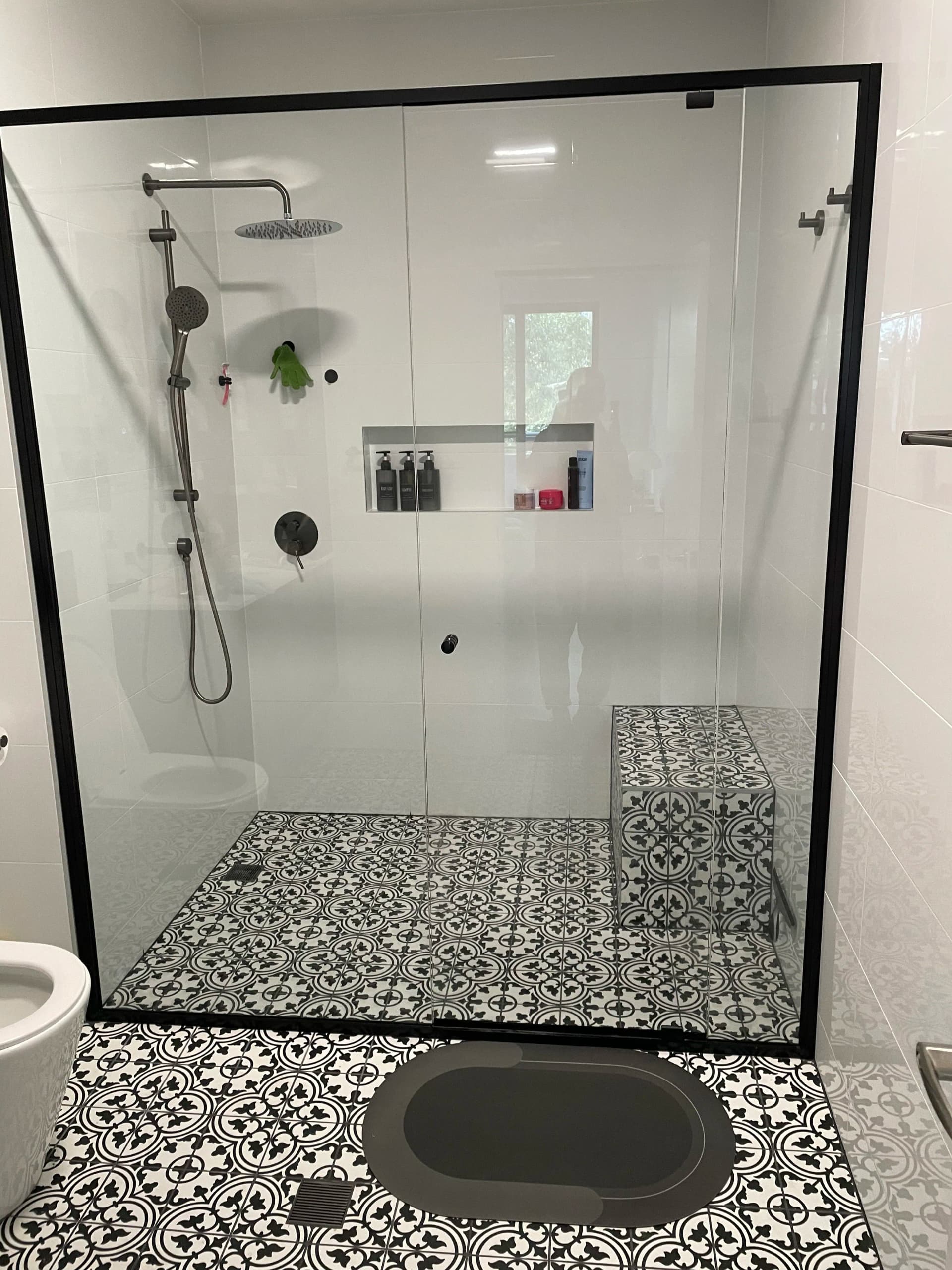
The short answer
NSW law requires every apartment wet area to be waterproofed to AS 3740, the standard called up by the National Construction Code. In a bathroom that means the shower floor and enclosed shower walls waterproofed to 1800mm, a 150mm upturn at other wall junctions, graded falls to the waste, and the entire floor sealed because it sits above another home. The work must be done by a licensed waterproofer who issues a certificate. Once you renovate, the leak liability becomes yours, forever.
Years in apartments
Projects completed
5-star Google reviews
Strata approval rate
Most waterproofing guides quote AS 3740 once and move on. This one is built for Sydney apartment owners, because in an apartment the rules are stricter, the consequences are worse, and the liability lands on you in a way it never does in a freestanding house. Here is exactly what the standard requires, why an apartment is different, and what compliance actually looks like on paper.
What does NSW law require for waterproofing an apartment bathroom?
It requires the wet area to be waterproofed to AS 3740, the Australian Standard the National Construction Code references for waterproofing of domestic wet areas. AS 3740 sets the minimum membrane heights, the falls to the floor waste, and the treatment of every junction and penetration. In a Class 2 building, which is what an apartment block is, that standard is not advice. It is the compliance benchmark a certifier, a strata committee, and an insurer will all measure your work against.
The other half of the picture is who is allowed to do it. In NSW, residential building work over $5,000 in labour and materials must be carried out by a licensed contractor, and a bathroom renovation always passes that line, so the waterproofing is laid by a licensed tradesperson and the finished work is backed by a statutory warranty under the Home Building Act. Miss either part, the standard or the licence, and the work is non-compliant even if it looks perfect.
What AS 3740 actually requires
AS 3740-2021 is specific. These are the minimums a licensed applicator works to, and the points a strata certifier checks. The membrane is a continuous tanked layer, not a coat of paint, taken up the walls and across the junctions so water has nowhere to escape.
| Area | What the standard requires |
|---|---|
| Enclosed shower walls | Waterproofed to at least 1800mm above the finished floor |
| Shower floor | Whole floor area of the shower, graded to the waste |
| Other wall and floor junctions | Minimum 150mm upturn up the wall |
| Walls behind a bath or basin | At least 150mm above the fixture |
| Hobs, steps and the shower threshold | Waterproofed in full, over the whole hob |
| Falls to the floor waste | Graded so water runs to the drain, minimum 1:80 |
| Penetrations (taps, outlets, wastes) | Each one individually sealed and flashed |
| The bathroom floor in an apartment | The entire floor, because it sits above another home |
Source: AS 3740-2021 Waterproofing of domestic wet areas, the standard referenced by the National Construction Code (NCC 2022 Volume One, Part F2 and Specification 26) for wet areas in Class 1 and Class 2 buildings. The full standard is published by Standards Australia.
The whole-floor rule is the one apartments get caught on
Why waterproofing an apartment is different
Three things change the moment the bathroom is in a strata building rather than a house. Each one raises the stakes on a layer that is only a few millimetres thick.
The floor is someone else's ceiling. A failed membrane in a house leaks into your own subfloor. The same failure in an apartment leaks into the unit below, damaging their ceiling, their cornices, and sometimes their kitchen. The damage is no longer contained to your property, which is why the standard is stricter and the liability is heavier.
The slab and the pipes are common property. The structural slab your bathroom sits on, and often the in-slab drainage, belong to the owners corporation, not to you. Cutting into them, or relying on the original membrane bonded to them, drags the building's shared property into your renovation and into the approval you need.
The original membrane was the building's responsibility, until you touch it. While the bathroom is original, the owners corporation maintains the waterproofing as common property. The day you strip it out and lay your own, that responsibility moves to you. More on exactly how that transfer works below.
The strata by-law and the leak-liability transfer
Renovating an apartment bathroom needs strata approval because it affects waterproofing and common property, which makes it major work under the Strata Schemes Management Act 2015. Approval is granted by a special resolution and a registered by-law, usually a common property rights by-law. That by-law is where the liability quietly changes hands.
Under the Act, the owners corporation has a duty to maintain and repair common property (section 106), and the original waterproofing membrane is common property. When you alter that common property to renovate, section 108 requires the approving special resolution and by-law to set out who maintains the new work, and for a private bathroom that responsibility is placed on you, the lot owner. So the original bathroom is the building's problem, and your renovated bathroom is yours. That responsibility runs with the lot, which means it passes to whoever buys your apartment next.
Once you renovate the bathroom, the leak is yours, forever
“The building part is fine. It's the getting-permission-from-strata part that makes me want to give up. Engineered drawings, a full schedule of works, and insurance certs. For a bathroom.”
For the full picture of how by-laws are drafted, costed, and registered, read our guide to strata by-laws and renovation rules in NSW.
Who can legally do the waterproofing
A licensed contractor. In NSW, residential building work valued over $5,000 in labour and materials must be carried out by the holder of a contractor licence, and a bathroom renovation clears that line every time, so the waterproofing is laid by a licensed tradesperson, not a handyman. Whatever the dollar value, the membrane still has to comply with AS 3740 under the NCC. A reform has been proposed to make a dedicated waterproofing licence compulsory at any value, but that is not yet law, so the contractor licence is the thing to insist on today.
When the work is done, the applicator issues a waterproofing certificate of compliance to AS 3740. That document is what a certifier, a strata committee, and your insurer rely on, and it is what a future buyer's conveyancer will ask for. Keep it, along with the photographic record of the membrane before it was tiled over.
Unlicensed waterproofing strips your practical protection
What compliant waterproofing costs
Waterproofing a standard apartment bathroom to AS 3740, by a licensed applicator and including the certificate, costs roughly $500 to $750. It is one of the cheapest line items in the entire renovation and the one you should never shop on price. The number rises with a larger floor, a fully tanked room, or a complex layout with multiple penetrations, which older buildings often have. Our Surry Hills apartment renovation guide covers what those buildings typically need.
| Item | Typical Sydney cost |
|---|---|
| Waterproofing to AS 3740, licensed, with certificate | $500 to $750 |
| Flood test before tiling | Included in a proper job |
That is the membrane only. For the full cost of an apartment bathroom renovation, broken down line by line, see our apartment bathroom renovation cost guide. We keep the costing there so this page can stay focused on compliance.
What happens if the waterproofing fails
A failed membrane in an apartment is rarely a small repair. Water finds the ceiling below, and putting it right usually means stripping the tiles and the membrane, re-waterproofing, re-tiling, and repairing the damaged unit downstairs. Because the liability sits with you under the by-law, the bill is yours.
There is a statutory backstop, but it is time-limited. Under the Home Building Act 1989, licensed building work carries a six-year warranty for major defects and two years for other defects, measured from completion. A waterproofing failure that makes the bathroom unusable generally counts as a major defect, so a licensed job gives you a claim an unlicensed one never could. Past those windows, or with no licensed applicator on record, the cost falls entirely on the owner.
“I feel like I went backwards. Years of hard work gone to the trash instantly, only because of buying a unit.”
Water ingress is one of the most common causes of strata special levies in older Sydney blocks. Doing the membrane properly the first time, to the standard, with the certificate, is the cheapest insurance you will ever buy on the job. See a high-rise apartment bathroom we waterproofed and finished to strata standard in our Sydney CBD high-rise case study, or follow a full job from approval to handover in our Artarmon apartment renovation case study. Waterproofing is priced and certified inside every apartment renovation we quote.
Get your apartment bathroom waterproofed to standard
30 years of Sydney apartment and strata renovations. Licensed waterproofing to AS 3740, the certificate, the flood test, and the by-law handled. Fixed price, no surprises.
Frequently asked questions
Go deeper
The complete Sydney strata approval guide
The by-law, the works application, and how to get a bathroom approved without months of back-and-forth.
Ready to start
Apartment bathroom renovations Sydney
Strata-compliant bathroom renovations by a 30-year specialist. Licensed waterproofing, certificate, fixed price.